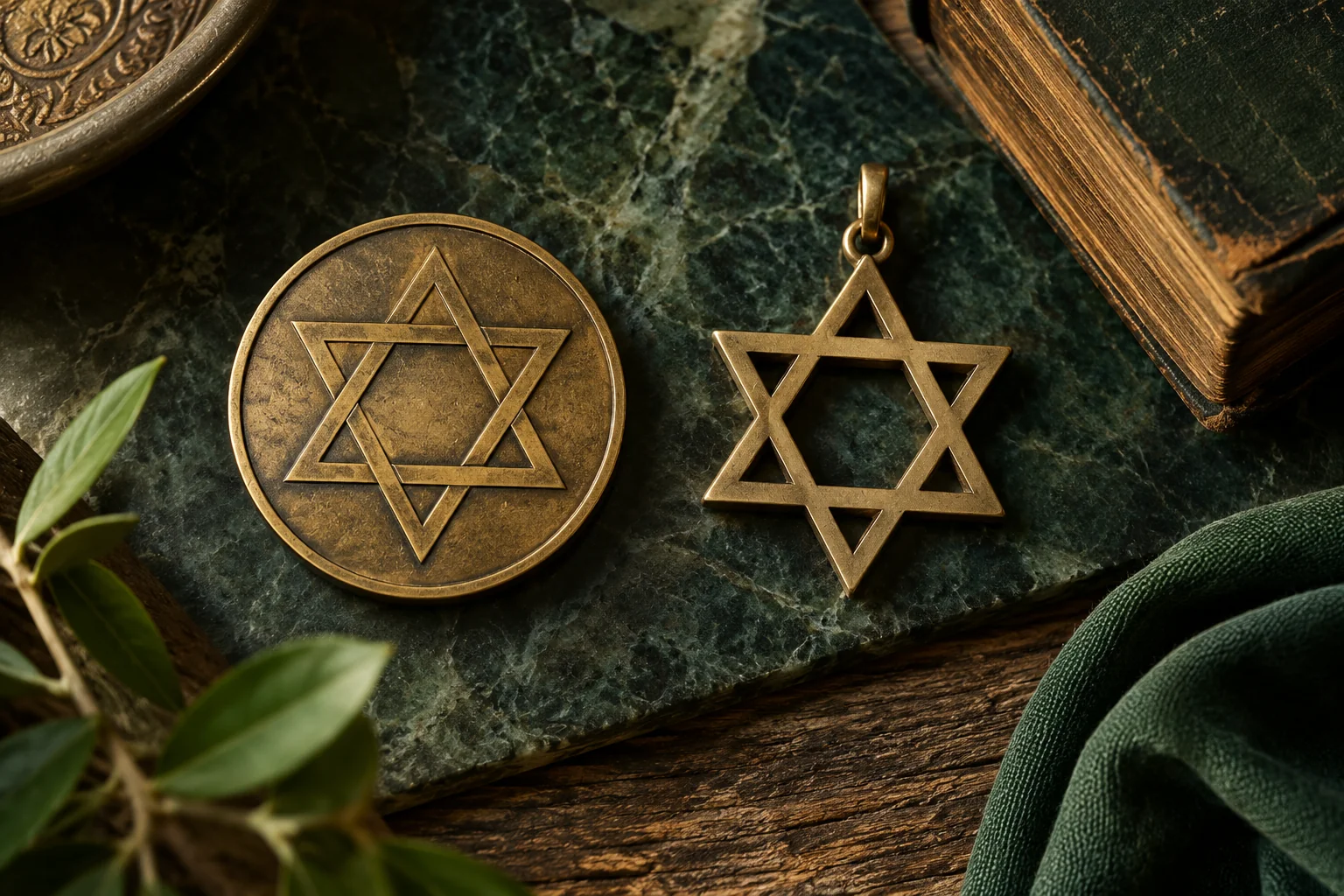
The Seal of Solomon and Star of David can share the same six-pointed geometric form: a hexagram made from two overlapping triangles. A shared shape does not make the names interchangeable in every context. The inscription, provenance and way an object was used help explain which meaning is intended.
For jewellery and talismans, the careful question is therefore “what does this particular object represent?” rather than “what does every six-pointed star mean?”
The geometry is only a starting point
A hexagram describes a visible arrangement of six points. It is a useful word when you can recognise the shape but do not yet know its cultural meaning. It does not, by itself, date a piece or prove its connection to a particular practitioner, community or historical owner.
A photograph can also conceal details. Check whether the design actually consists of two triangles, an interlaced pattern, a surrounding inscription or another arrangement. Describe what is visible before assigning a name.
The Seal of Solomon in a talismanic context
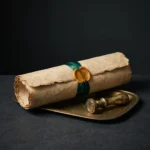
The Met’s description of its Talismanic Scroll identifies the six-pointed star in that Islamic art context as Solomon’s seal. The object is an eleventh-century block-printed paper scroll attributed to Egypt. This gives a specific, documented example of the name in use, rather than proof that every similar star carries the same interpretation.
When a modern maker calls a ring a Seal of Solomon ring, ask what they mean by that name and how the surrounding text or preparation relates to it. A product name is an interpretation to clarify, not independent evidence of antiquity.
The Star of David and Jewish identity
The Jewish Museum explains that the hexagram appeared in multiple cultural settings before its later development as a widely recognised emblem of Jewish identity. Its Signs and Symbols collection text describes communal adoption in Prague, broader recognition in the nineteenth century and its place on Israel’s flag in 1948.
That history is a reason to respect the symbol’s living Jewish significance. A geometric overlap should not erase the identity, religious practice or personal meaning associated with a particular object.
A practical comparison
| Question | Seal of Solomon | Star of David |
|---|---|---|
| What can the shape be? | A hexagram in the historical example discussed here. | The familiar six-pointed hexagram. |
| What context matters? | The maker’s explanation, talismanic text and documented tradition. | Jewish cultural, communal or religious use and the object’s history. |
| Can appearance alone identify it? | No; ask about inscription and provenance. | No; consider inscription, use and provenance. |
How to read a ring or pendant listing
Ask for a clear front photograph and an explanation of the inscription. If a claim about age or origin matters to the price, request the evidence supporting it. Newly made symbolic jewellery should be presented as newly made, even when a historical motif inspired its design.
Material details also matter: the metal, finish, dimensions, size and care guidance remain practical facts regardless of the symbolic interpretation. A star motif alone cannot verify a spiritual effect or establish a guarantee.
Continue with the object, not just the name
Read our Seal of Solomon ring buying guide for questions about design and specifications, or our Arabic talisman guide for inscription-focused enquiries. If you are interested in a Dar Talisman piece, speak with the Sheikh about how that specific design is described and prepared.